RCCBs (Residual Current Circuit Breakers) provide critical protection against electric shock, yet in many residential and industrial projects, poor performance is caused by incorrect installation. In real world applications, mistakes like improper circuit grouping and wiring errors appear repeatedly. These issues reduce system reliability and can compromise safety.
A successful installation requires more than just mounting the device on a DIN rail. It demands a deep understanding of leakage current behavior and circuit logic. Failing to address these factors often leads to the same outcome: a system that trips without a fault or fails to protect when a real hazard occurs.
1. Excessive Circuit Grouping
One of the most frequent mistakes is connecting too many final circuits to a single RCCB. While this approach reduces hardware cost, it significantly increases the risk of nuisance tripping. Every electrical circuit has a natural background leakage current. When lighting, power sockets, and electronic equipment are all grouped under one device, their individual leakage currents combine.
Even if every appliance is functioning perfectly, the total cumulative leakage can easily reach the 30mA threshold. A professional installation should divide circuits into smaller groups or utilize individual RCBOs. To understand how this imbalance is detected, you should read about the basic RCD working application in modern wiring.
2. Shared Neutral Wiring Errors
Improper wiring of the neutral conductor is a major cause of immediate tripping after installation. In many retrofit projects, installers mistakenly share a single neutral bar across multiple RCCBs or mix the neutral wires of different circuits.
An RCCB functions by comparing the current in the live and neutral wires. If the neutral current from one protected circuit returns through the neutral bus of a different RCCB, both devices will detect an imbalance and trip instantly. Every RCCB must have its own dedicated and isolated neutral conductor. Many installers still confuse this with older earthing methods. It is vital to understand the difference between ELCB and RCCB before finalizing a design to ensure the correct protection method is applied.
3. Incorrect Sensitivity Selection
Choosing the wrong sensitivity compromises either safety or stability. A common mistake is using a 100mA or 300mA RCCB for final circuits such as bathroom sockets where 30mA is mandatory for human safety. This error leaves users exposed to lethal shocks.
Conversely, using an ultra-sensitive 10mA device on a circuit with heavy motor loads or large LED banks will lead to constant interruptions. For professional installers, following a standardized RCCB selection is the best way to avoid mismatching breakers with modern electronic loads.
4. Improper Device Type Application
A growing mistake in modern installations is the use of standard Type AC RCCBs for circuits containing sophisticated electronics. Standard Type AC devices are only designed to detect pure sinusoidal AC leakage. However, modern loads like EV chargers, solar inverters, and variable frequency drives (VFDs) produce pulsating DC leakage.
This DC component can saturate the magnetic core of a Type AC breaker, a phenomenon known as blinding. This prevents the device from tripping even during a dangerous fault. Installers must ensure that Type A or Type B RCCBs are specified for any circuit powering modern electronic power supplies or high tech appliances.
5. Poor Vertical Coordination
In multi level distribution systems, a lack of coordination between upstream and downstream RCCBs can lead to total power failure. A common error is installing RCCBs with the same sensitivity and timing at both the main distribution board and the local branch boards.
If an earth fault occurs at a socket, the upstream main breaker might trip faster than the downstream branch breaker. Proper coordination requires using a time delayed, or S-Type, RCCB at the main intake. This ensures that only the affected local circuit is isolated.
6. Incorrect Terminal Torque and Connection
A purely mechanical mistake that often leads to catastrophic failure is improper terminal torque. If the wires are not tightened to the manufacturer’s specifications, high resistance connections are formed. This generates heat and can eventually cause the plastic casing of the RCCB to melt or catch fire.
Furthermore, some installers confuse the Line and Load terminals. While many mechanical RCCBs are bi-directional, some electronic versions or specific RCBO models require the supply to enter through the top terminals only. Reversing this orientation can damage the internal sensing electronics during a fault condition.
7. Neglecting Environmental Derating
Installing an RCCB in an environment for which it was not designed is a recipe for failure. RCCBs generate a small amount of heat during operation. If they are packed tightly in a small enclosure without ventilation, or placed in a high temperature environment like a direct sunlight exposed DB box, the internal components can drift in sensitivity.
In industrial areas with high dust or corrosive gases, the mechanical latch can become sticky over time. This makes regular testing via the Test button even more critical to ensure the device has not seized up due to environmental contamination.
Conclusion
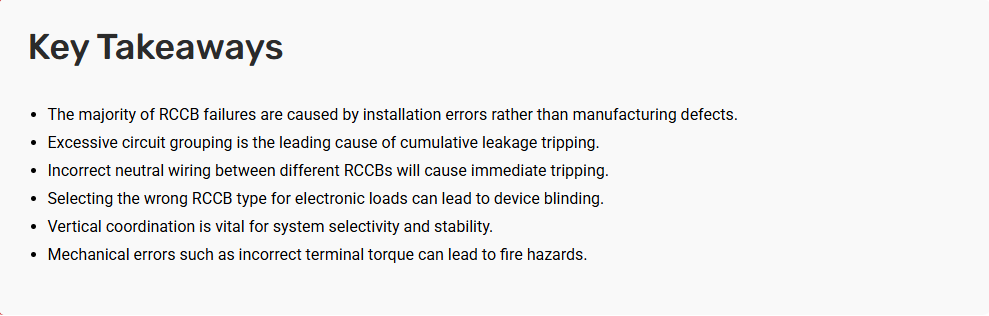
Most RCCB problems are not caused by the device itself but by how it is integrated into the electrical system. Incorrect grouping, unsuitable sensitivity selection, and fundamental wiring errors are the primary reasons for instability and repeated tripping. By addressing these common mistakes during the design and installation phases, it is possible to significantly improve both the safety and the performance of the system.
Proper installation demands professional grade components. As a leading residual current circuit breaker manufacturer, Moar provides the full suite of RCCBs needed for segmented and coordinated power distribution. Partner with us to ensure your projects are built to international safety standards and free from common wiring errors.

Leave a Reply