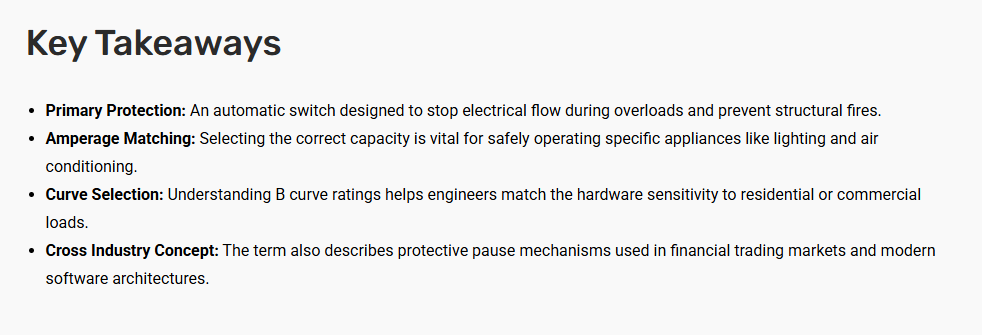
Electricity powers our modern lives but it requires strict control to remain safe. Understanding what a circuit breaker is used for serves as the foundation of panel design. This module acts as an automatic safety gate that monitors the current flowing through your property to prevent catastrophic hardware failures.
When an overload occurs this device immediately disconnects the power supply. This rapid response prevents wires from melting and eliminates severe fire hazards. Exploring different capacities and specialized designs helps homeowners and engineers ensure that their infrastructure remains reliable and secure under any operating condition.
The Core Purpose of Electrical Protection
How Internal Components Work Together
To understand the mechanics you must ask how does a circuit breaker work internally. Most residential modules utilize a thermal magnetic system. A bimetallic strip bends slowly to break the circuit during a gradual overload. Meanwhile an electromagnetic coil reacts instantly to cut power during a massive short circuit.
Visualizing the Circuit Diagram
The physical structure includes several vital circuit breaker components that handle extreme energy safely. These parts feature the main electrical contacts and an arc chute to cool the resulting electrical flash. Engineers often rely on a detailed circuit breaker circuit diagram to visualize how these internal elements coordinate perfectly.
Heavy Duty and Substation Protection
Comparing Standard Units to MCBs
Professionals often compare a standard circuit breaker vs mcb to determine the appropriate scale of protection. A miniature circuit breaker serves domestic panels with lower current demands while heavy duty molded case units manage industrial loads. You can consult a types of circuit breakers pdf to review detailed specifications.
Managing High Voltage in Substations
At the grid level the equipment scales up drastically. A massive circuit breaker in substation environments handles thousands of volts to protect entire city sectors. These advanced circuit breakers types use vacuum or sulfur hexafluoride gas to extinguish massive arcs ensuring that regional power grids remain stable and secure.
Sizing Guide by Amperage Capacity
Standard 20 Amp and 30 Amp Applications
Choosing the correct capacity prevents nuisance tripping. A 20 amp circuit breaker is used for standard kitchen countertop outlets and managing medium household appliances safely. Stepping up the power a 30 amp circuit breaker is used for dedicated heavy loads like electric water heaters and standard residential laundry dryers.
Heavy Duty 40 Amp Requirements
Larger household infrastructure requires significantly more stable power. A 40 amp circuit breaker is used for demanding climate control systems or electric cooking ranges. This massive capacity ensures that heavy duty appliances receive consistent power without dropping the connection during high energy startup cycles in the peak summer heat.
Decoding B Curve MCB Ratings
Sensitive B6 and B16 Installations
Trip curves define the exact sensitivity of the protection module against surges. A b6 circuit breaker is used for highly sensitive residential lighting circuits with minimal startup spikes. Meanwhile a b16 circuit breaker is used for standard European wall sockets dealing with purely resistive loads and daily household electronics.
High Capacity B32 and B40 Uses
Higher B curve ratings manage much larger resistive power draws. A b32 circuit breaker is used for dedicated subpanel feeds or high capacity electric showers. Similarly a b40 circuit breaker is used for heavy domestic cooking appliances where the continuous load is high but the startup surges remain relatively low.
Space Saving and Tandem Solutions
Expanding Panels with Tandem Breakers
Running out of physical space in a distribution board is a frustrating problem. A tandem circuit breaker is used for solving this exact issue safely. This specialized component squeezes two independent switches into a single panel slot providing safe expansion without requiring a costly and complex total panel replacement.
The Term in Finance and Software
Market Halts and Financial Trading
This protective concept extends far beyond electrical engineering. A circuit breaker in the stock market is a crucial financial safety mechanism. Trading platforms automatically halt all buying and selling when prices drop too rapidly preventing catastrophic panic selling and giving investors time to process vital global market information.
Preventing Microservice Cascading Failures
Software engineers also utilize this exact concept for digital stability. In microservices a circuit breaker is used for preventing cascading failures across complex network systems. It automatically stops sending requests to a failing external server ensuring the main software application remains online safely while the secondary service recovers.
Conclusion and Final Recommendations
Whether managing electrical currents or stabilizing digital networks the core concept of this protective mechanism remains identical. An automatic safety cutoff prevents localized faults from turning into widespread disasters. Knowing how to select the right capacity and curve ensures that your physical infrastructure operates with maximum efficiency and total safety.
At GEYA we manufacture a comprehensive range of premium protection modules for every conceivable application. Our reliable hardware meets strict international safety standards to protect both residential homes and massive industrial facilities. Choosing the correct protective component guarantees that your electrical distribution system remains secure under the most demanding conditions.

Leave a Reply